
What it wants
For the loss to be seen, honored, and held with gentleness—without being rushed or fixed.
vulnerable
What it wants
For the loss to be seen, honored, and held with gentleness—without being rushed or fixed.
What it fears
That the pain will be forgotten, which feels like a second loss. It also fears being told to "get over it."
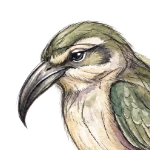
This isn’t the loud, wailing bird of fresh tragedy. The Grief Bird is quieter, more constant. It’s the weight in your chest on a perfectly fine Tuesday. It’s the hollow ache that appears when you see a family and remember the one you wished you had, or when a friend announces a success that reminds you of a dream you had to let go. It holds the sorrow for *what wasn’t* — the support you never got, the safety you didn’t feel, the versions of you that never got to fledge. It doesn’t cry for attention. It just sits with you, a heavy, feathered presence reminding you that every life is shadowed by the lives we didn’t get to live.
The Grief Bird doesn’t build a nest of twigs, but of absences. It roosts in the quiet spaces left behind—in the empty chair at the table, the silence on the other end of the phone, or the unreached milestone on the calendar. It appears softly on anniversaries, during sentimental movies, or in the stillness of a lonely evening, its quiet presence a testament to what is no longer there.
What tends to bring it out
"It wasn't supposed to be like this."
"No one remembers how much this still hurts."
"What if things had been different?"
"It's just not fair."
When confronted with forced cheerfulness or invalidation, the Grief Bird doesn't attack. It pulls its wings in tight, goes utterly still, and makes your whole system feel heavy as lead, retreating deep into the quietest, darkest part of the Sanctuary.
Masking behaviours
Birds rarely act alone. These are some of the Birds that often travel nearby.
vulnerable
They often sit on the same branch. The grief over a lost connection is what creates the space where loneliness now lives.

vulnerable
Shame often rushes in to explain the grief. The sorrow feels so big, there must be a reason for it — and the reason must be you.

vulnerable
They are two sides of the same coin. The Grief Bird often mourns the childhood or freedom that the Burdened Bird had to sacrifice.

planner
The Critic is often terrified of the Grief Bird's stillness. It will try to bully it into action ('Stop moping!') to avoid feeling the vulnerability of pure sadness.
Linked Experiences
These Experiences ground the Bird in real life. They show the moments where this protective pattern often appears.
Explorer shows the broad version of the experience, without narrowing it to one neurotype.
Changing this updates how BirdStory explains experiences in your guide.
These views change the wording and examples BirdStory shows. They are not a diagnosis.
Pick the view that makes the experiences feel most recognisable.
Supporter View
When your loved one’s Grief Bird is present, they may seem distant, quiet, or sad for no clear reason. This guide helps you understand the deep, old sorrow they’re carrying, so you can offer support that feels like a warm blanket, not an interrogation.
More support
Explore the Experiences where this pattern shows up — real moments that ground the Bird and point to what can help.
Sign in or create a free account to save this entry.
We'll email you a link to sign in instantly.